It depends entirely on what is in the plan. A case built around whitening and bonding can be finished in a couple of appointments over a few weeks. A case involving gum treatment, several veneers and a crown runs over a few months, mostly because healing and shade stabilization need time rather than because the appointments are long. We will give you a dated sequence at planning so you can work around anything you have coming up.
Smile Makeovers in Vestal, NY
You already know whether you want one. People who are happy with their smile do not read pages like this.
So rather than asking whether you cover your mouth when you laugh, this page covers the part nobody explains: what a smile makeover actually consists of, how a case gets planned, and what separates a result you love from one that looks like dental work.
I was treated with kindness, compassion and understanding... My concerns were answered and I never felt pressured or rushed. After my visit, I spoke with Grace, the care coordinator. She too, was patient and kind. I am confident that my plan of care will meet my expectations.
Pauline M. · Google Review
I've been to several dentists throughout our area over the years, most of which left me disappointed and even in tears once. I am beyond satisfied with Vestal Dental Associates. Not only is the quality of services top notch, the staff is incredibly kind and empathetic which is so important to me!
M. M. · Google Review
Recent Transformations
Cosmetic work is judged by eye and nothing else. These are our own patients.
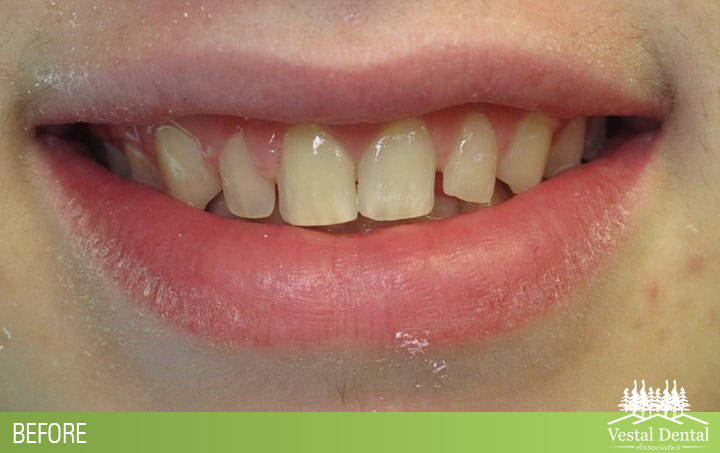
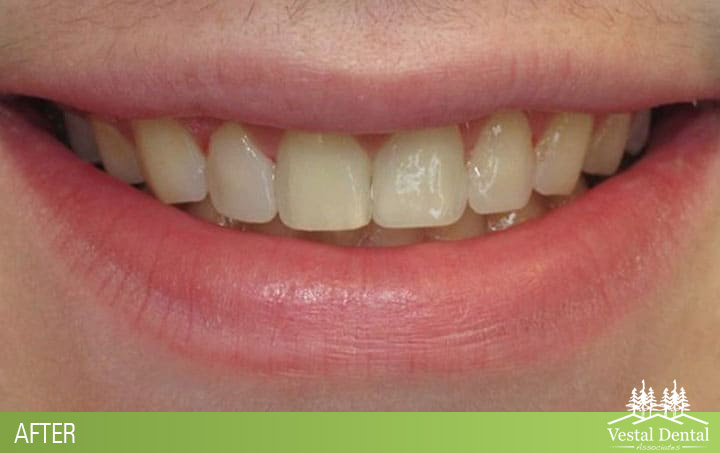
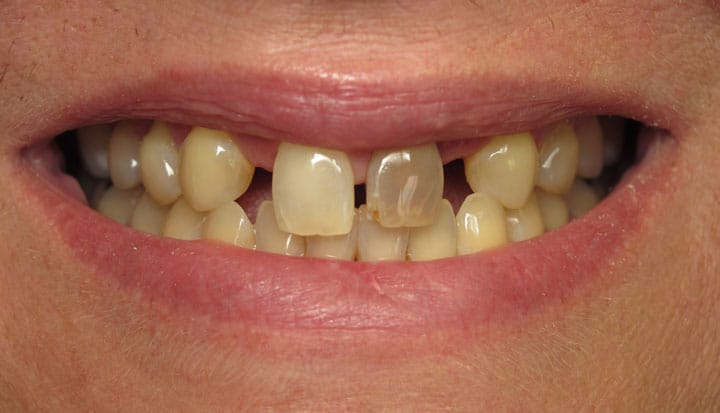
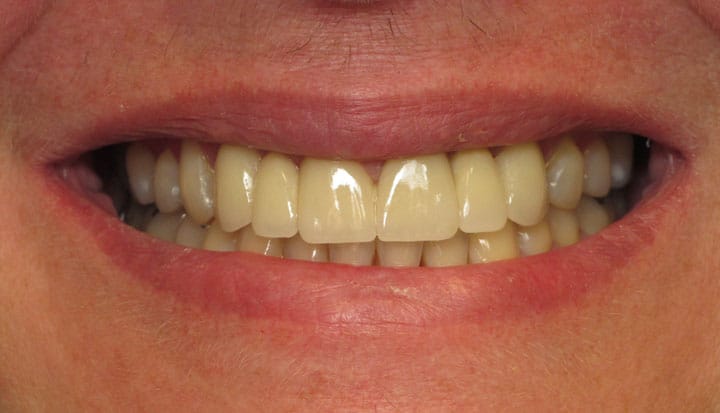
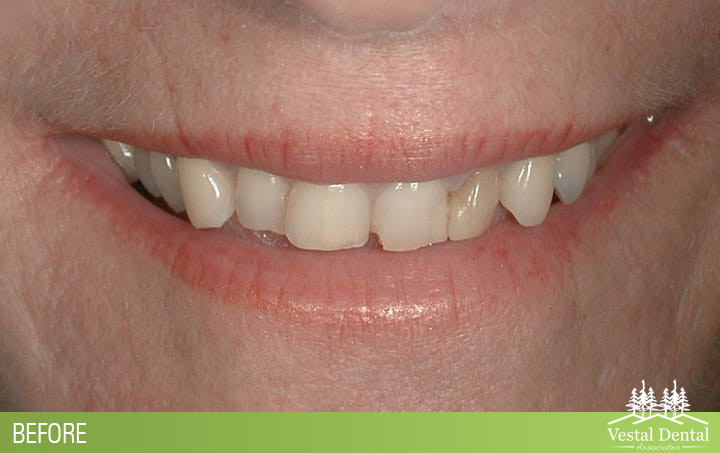
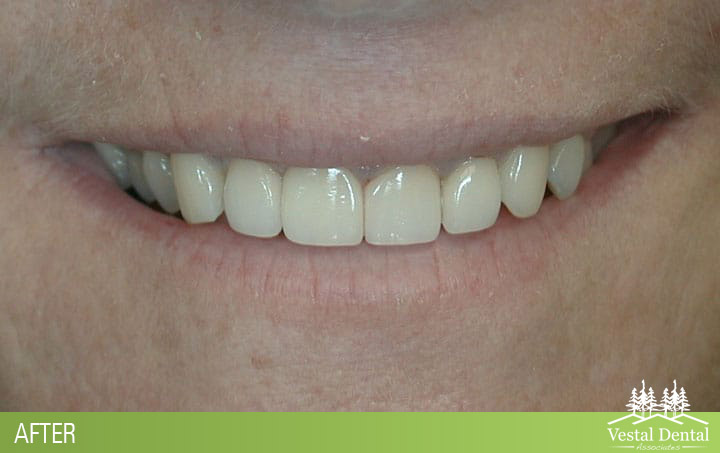
There are more in our full before and after gallery.
A Smile Makeover Is a Plan, Not a Procedure
This is the thing most people get wrong on arrival. There is no single treatment called a smile makeover. It is a coordinated sequence drawn from the same treatments we do every day, chosen and ordered to produce one result.
A case might involve whitening to set the base shade, bonding to reshape one or two teeth, veneers across the teeth that show, a crown on a tooth that needs protecting anyway, and gum treatment to even out a gum line. Or it might involve two of those. The skill is in deciding which, and in what order.
Order matters more than people expect. Whitening comes first, always, because porcelain and composite do not lighten afterward. Gum health comes before anything cosmetic, because a beautiful restoration on an inflamed gum line looks wrong within two years. Structural problems get solved before appearance, because there is no sense putting porcelain on a tooth that is going to fracture.
How a Case Gets Planned
Nothing is prepared at the first appointment. What happens instead is records and conversation.
Photographs and models, so the case can be studied outside your mouth. A look at what actually shows when you talk and smile, which is different for everybody and determines where effort is worth spending. A conversation about how much change you want, because "natural" and "dramatic" mean very different things to different people and the word alone is not enough. And an honest assessment of what your teeth and gums can support.
Then you see a plan before anything irreversible happens. We have an in-house lab and our own milling and ceramic furnace, which means design decisions get made here with your case in front of us rather than described down a phone line to a technician who has never met you.
If you have not seen a plan, do not agree to preparation.
Front teeth are not somewhere to find out what you think afterward. You should see a design, understand exactly which teeth are being altered and how permanently, and know what the result will look like before an instrument touches anything.
Makeover or Reconstruction?
These overlap and people mix them up, so here is the distinction as we use it.
A smile makeover is led by appearance. The teeth function adequately and the goal is how they look.
A full mouth reconstruction is led by function. Bite collapse, extensive wear from years of grinding, multiple failing restorations, missing teeth. Appearance improves considerably, but it is driven by rebuilding a working bite.
Plenty of cases sit between the two, and the distinction matters mostly because it changes who leads, how long it takes and how insurance treats it. Dr. Fritz Zietsman is a board eligible prosthodontist, which is the specialty for the reconstructive end, and our Learning Center compares the two approaches directly.
Smile Makeover Questions We Hear
-
How long does the whole thing take?
-
Will it look obvious?Only if it is designed that way. The uniformly bright, uniformly square look people fear is a set of design choices, not an unavoidable outcome. Natural teeth vary in length and shade, are translucent at the edges and are not symmetrical. A good result reproduces that. Bring photographs of results you like and, just as usefully, ones you do not, because that tells us more than adjectives do.
-
Can I do it in stages as I can afford it?Frequently yes, and it is a sensible way to approach a larger case. The important part is that the whole plan gets designed first even if it is delivered over two or three years, because each stage has to be built toward the final result. Treating one tooth at a time without a plan is how people end up with mismatched work that has to be redone. Tell us the budget and the timeline at the start and we will sequence around them.
-
What if I only actually need one thing?Then we will tell you that, and it happens often. Plenty of people arrive expecting a full case and leave with whitening and a single bonded tooth, because that was what was bothering them. The consultation exists to find out what would make the difference, not to maximize what gets sold. A smaller plan that solves the actual complaint is a better outcome than a larger one that impresses.
-
How long will the result last?It depends on what is in it. Bonding typically wants refreshing every five to ten years, porcelain commonly lasts well beyond a decade, and whitening needs occasional topping up. Three things shorten all of them: grinding, gum disease and using teeth as tools. If you grind, a night guard is part of the plan rather than an optional extra, and we will say so before starting.
-
Does insurance cover any of it?Purely cosmetic treatment generally is not covered. However, parts of a plan often have a genuine restorative or periodontal justification, a cracked tooth that needed a crown regardless, or gum treatment that was clinically indicated, and those elements frequently are. We separate the plan into what is likely to attract coverage and what is not, so you see both numbers rather than one lump sum. Our payment options page covers the financing most cosmetic cases use.
Start with a plan and a photograph.
A smile makeover consultation costs you an hour and tells you what is possible, what it would involve and what it would cost. You see the design before anything is prepared.
Proudly Serving Patients in the Following Communities
- Apalachin NY
- Bainbridge NY
- Binghamton NY
- Castle Creek NY
- Chenango Forks NY
- Choconut PA
- Conklin NY
- Coventry NY
- Endicott NY
- Endwell NY
- Greene NY
- Harpursville NY
- Johnson City NY
- Kirkwood NY
- Little Meadows PA
- Maine NY
- McDonough NY
- Norwich NY
- Owego NY
- Oxford NY
- Port Crane NY
- Port Dickinson NY
- Triangle NY
- Vestal NY
- Windsor NY
