It will protect your teeth from further damage and it very often reduces muscle pain and morning headaches, which for many patients is most of the problem solved. What it does not do is stop you clenching, because clenching originates in the brain, not the mouth. Think of it as removing the damage rather than removing the habit. For a joint problem driven by a displaced disc or arthritis rather than by muscle overwork, a splint helps but is not the whole answer. And a night splint is not a sports guard, which is a different appliance for a different job, covered on our sports mouth wear page.
TMJ and Jaw Pain Treatment in Vestal, NY
Headaches most mornings. A jaw that clicks, or catches, or aches by the afternoon. Teeth that are visibly shorter than they used to be. Pain that sits in front of the ear and spreads into the temple, the neck, the shoulder.
Most people with that combination have already been somewhere else. Usually more than one somewhere: a doctor who reasonably suspected sinus trouble, a neurologist who reasonably suspected migraine, a pharmacy shelf's worth of painkillers. What often has not happened is anybody examining the joint itself.
Is This TMJ?
First, a small clarification that matters. TMJ is the joint. TMD, temporomandibular disorder, is the problem with it. Everyone says TMJ, including us on this page, but what you are looking for is a diagnosis of TMD.
The temporomandibular joint sits just in front of each ear and is a genuine orthopedic joint, with a disc, a capsule and lubricating fluid, exactly like a knee or a shoulder. That framing is the useful one, because it explains both the symptoms and the treatment. Joints get inflamed. Discs slip out of position and click going back in. Muscles that work too hard get sore and refer pain elsewhere. None of that is mysterious, it is just happening somewhere people do not think of as a joint.
Symptoms that point toward it:
- Clicking, popping or a grating sound when you open or chew
- Jaw pain, or pain in front of the ear, often worse later in the day
- Headaches concentrated in the temples, frequently on waking
- The jaw locking, either open or closed, even briefly
- Teeth that are worn flat, chipped, or newly sensitive
- A bite that feels different from how it used to feel
- Neck and shoulder tightness with no other obvious cause
- Ear pain, fullness or ringing with a clear ear examination
One or two of these on their own may mean nothing. Several together, particularly with the morning headache and the worn teeth, is worth an examination.
Vestal Dental truly sets the bar for exceptional care. Dr. Zeitsman goes above and beyond with a level of precision and attention to detail that's hard to find. Before discovering this office, I was actually traveling out of state just to receive this caliber of dentistry, which speaks volumes.
Elizabeth C. · Google Review
What Is Actually Causing It
Usually not one thing, which is why single-cause explanations should make you suspicious. The common contributors are clenching and grinding, often at night and often entirely unknown to the person doing it; arthritis in the joint; a disc that has shifted out of position; an old injury to the jaw or the head; and periods of sustained stress, which drive the clenching that drives everything else.
Worn teeth are frequently the first hard evidence, because enamel does not wear evenly by accident. A partner's complaint about grinding noise at night is the second. Our Learning Center covers the signs of grinding you can spot yourself, and how TMJ affects people day to day.
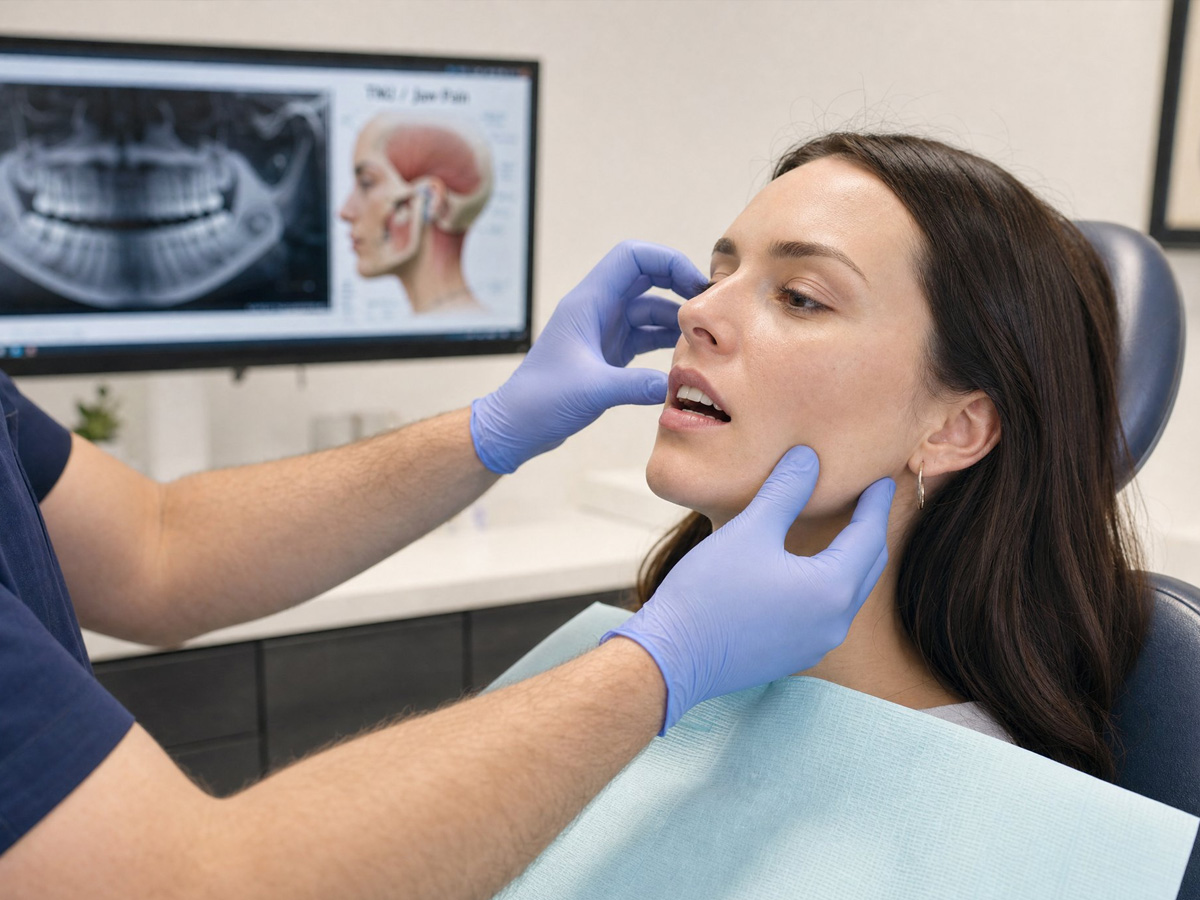
The examination is hands on and takes time. Nobody diagnoses this from a single x-ray.
We measure how far and how evenly the jaw opens, feel the joints and the muscles through a full range of movement, map where the pain actually refers to, and look at the wear pattern on your teeth. Our Orthophos SL 3D imaging shows the bony structures where that is relevant. See our knowledge and technology in full.
How It Gets Treated, In Order
The order is the important part, and it is where this page differs most from others you will read.
Conservative and reversible comes first. Soft diet for a period, heat and cold, gentle jaw exercises, deliberately breaking daytime clenching habits, and addressing sleep and stress where those are driving it. A surprising number of people improve substantially on this alone. It costs almost nothing and forecloses no options.
Then splint therapy. A custom occlusal splint, worn at night, stops the teeth destroying each other and lets overworked muscles settle. This is the single most useful intervention for most patients, and it is still completely reversible. The appliance itself, and how a custom one differs from the drugstore version, is covered on our occlusal night guards page.
Alongside that, adjuncts where they help. Anti-inflammatories, muscle relaxants prescribed by your physician, and physical therapy for the jaw and neck. We are comfortable co-managing with your doctor rather than pretending dentistry owns every part of this.
Restorative work last, and only when it is indicated. Where years of grinding have genuinely destroyed tooth structure, rebuilding the bite with crowns or a full mouth reconstruction can be the right answer. Dr. Fritz Zietsman is a board eligible prosthodontist, which is the specialty for exactly that kind of reconstruction, so when a case genuinely needs it the expertise is in the building. You can read about the whole team and what each of them focuses on.
Nothing that permanently changes your bite until the reversible options have had a fair run.
Grinding down healthy teeth to chase a jaw symptom is not something you can undo if it turns out not to have been the problem. If a practice proposes that as a first step, get another opinion.
TMJ Questions We Hear
-
Will a night guard fix this?
-
My jaw clicks but it does not hurt. Should I worry?Painless clicking is extremely common and, on its own, usually does not need treatment. Plenty of people click for decades without it becoming anything. Mention it at a routine visit so it is on record and we can watch the wear on your teeth, but a click with no pain, no locking and no limitation is not a reason to start therapy. Be wary of anyone who tells you otherwise.
-
Do I need an MRI or a special scan?Usually not. Most TMD is diagnosed from history and a careful hands-on examination, and imaging is ordered when it will change the plan rather than as routine. Our 3D imaging shows the bony anatomy of the joint well. Soft tissue detail, meaning the disc itself, needs an MRI, and that is a referral we make when the findings genuinely call for it.
-
Will I end up needing surgery?Almost certainly not. The overwhelming majority of TMD is managed without any surgical intervention at all, and surgery on this joint is reserved for a small number of cases with specific structural problems that have not responded to everything else. If surgery is the first thing somebody mentions to you, that is a reason to seek a second opinion rather than a reason to book it.
-
Can it resolve on its own?Yes, and often does, particularly where a stressful period was driving the clenching and that period ends. Symptoms can also come and go for years. What does not reverse is the tooth wear, which accumulates silently the whole time, and rebuilding badly worn teeth later becomes a much larger undertaking. That is the argument for protecting the teeth even during a quiet spell rather than waiting to see whether the pain comes back.
-
Is TMJ treatment covered by dental or medical insurance?It can fall under either, and occasionally neither, which makes this one of the more frustrating areas of coverage. Some dental plans cover occlusal splints, some exclude anything coded as TMD, and some medical plans will consider it. We will check your specific benefits and give you a written estimate before treatment starts. Our payment options page covers the plans we work with and the financing available.
Get the joint examined by someone who examines joints.
If you are living with morning headaches and a jaw that clicks, a proper TMD examination is a sensible next step. It is conservative, it is reversible, and it starts with a conversation.
Request an Appointment
Proudly Serving Patients in the Following Communities
- Apalachin NY
- Bainbridge NY
- Binghamton NY
- Castle Creek NY
- Chenango Forks NY
- Choconut PA
- Conklin NY
- Coventry NY
- Endicott NY
- Endwell NY
- Greene NY
- Harpursville NY
- Johnson City NY
- Kirkwood NY
- Little Meadows PA
- Maine NY
- McDonough NY
- Norwich NY
- Owego NY
- Oxford NY
- Port Crane NY
- Port Dickinson NY
- Triangle NY
- Vestal NY
- Windsor NY
